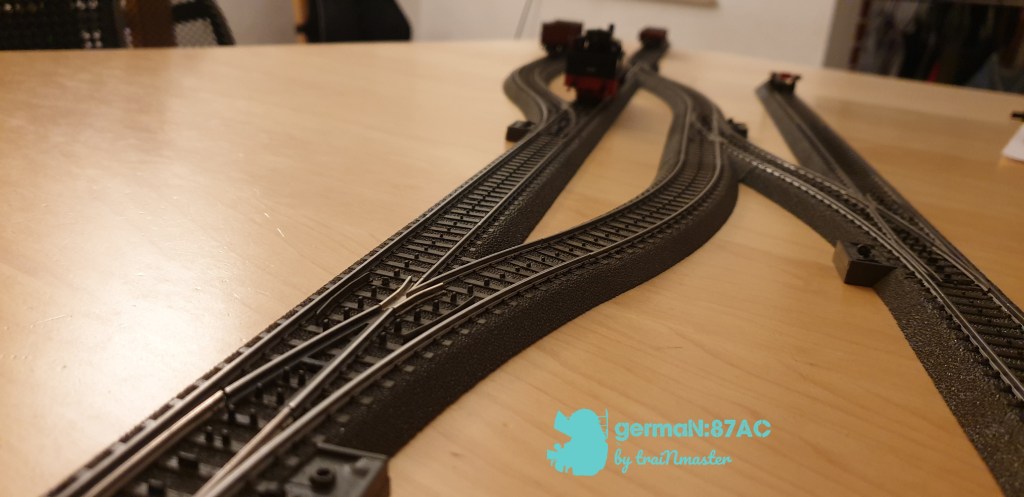
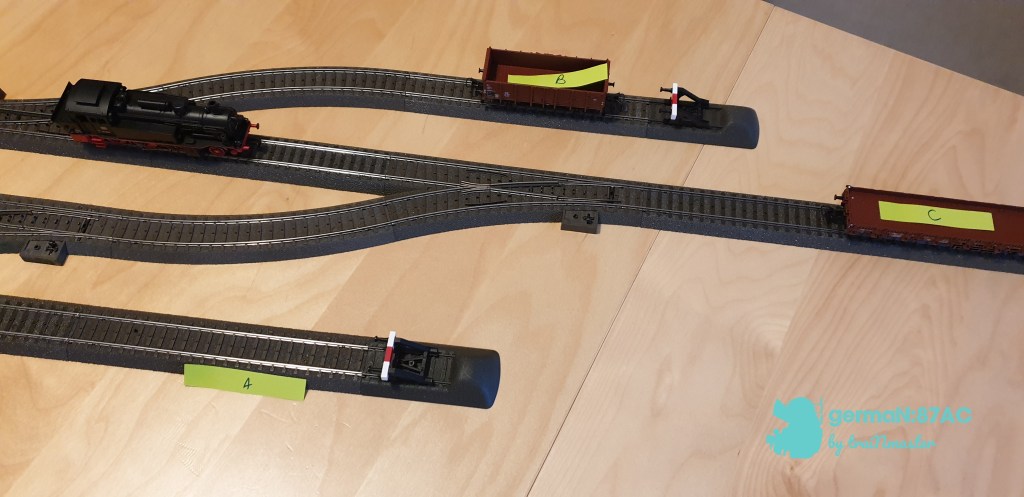
Note: I have updated this post with the latest setup and play manual instructions that I wrote and published (also see http://www.maerklintimesaver.wordpress.com). The changes will be marked in green.
I bought 22 pieces of pre-owned Märklin tracks and turnouts and managed to receive them before New Year Eve; in time for the annual Eve classic sketch – Dinner for One, starring Freddie Frinton as Butler James and May Warden as Miss Sophie. This 11-minute sketch tells the story of Miss Sophie celebrating her 90th birthday with 4 “imaginary” friends, who have all passed on.
At every dinner serving, the increasingly drunk butler James will ask Miss Sophie if it is the same procedure as last year; to which, Miss Sophie will always reply …. “same procedure as every year “. Watch the video.
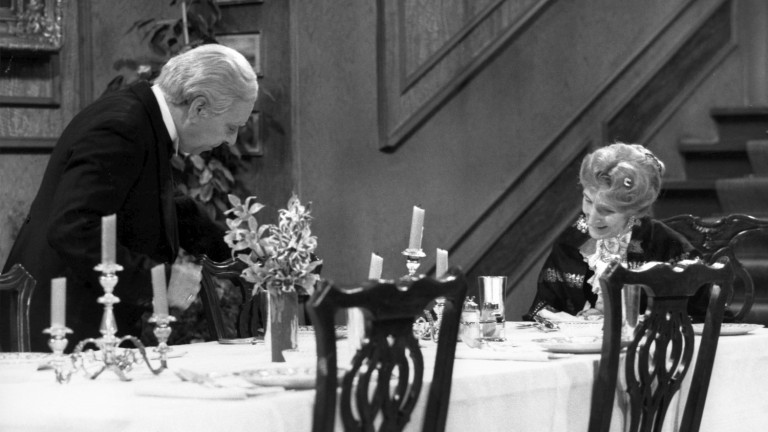
(Foto: picture alliance /dpa/WDTR/NDR)
While watching, I put together the tracks and turnouts for a Timesaver. Timesaver is quite popular among model-railroaders in North America (USA and Canada). John Allen (one of the 2 well-known “Johns” in the North America model railroad circle) conceived and published the shunting/switching puzzle in 1972.
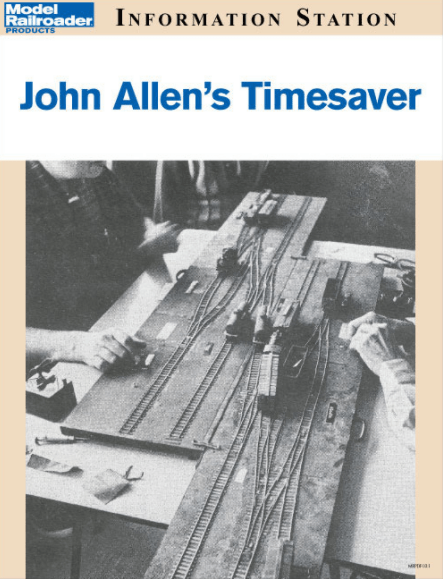
(Foto: Kalmbach Media)
The procedures and objects are simple:
- “Switch the cars (five based on John’s plan, you can vary them) to their destinations on the layout.”
- “Complete the switching as quickly as possible.”
Märklin/Trix C-Tracks “Timesaver for One” Materials List
I adapted the Timesaver track plan to (1) utilize as many existing tracks from Märklin digital starter set 29074 (or Trix equivalent 21528) as possible, and (2) minimize the use of space whilst preserving the structure and purpose of the puzzle.
Each siding can accommodate 2 or 3 cars including a tender loco i.e. 1 car + loco, 2 cars, 2 cars + 1 loco or 3 cars combinations. It is the challenge of the puzzle is to see if you could shunt the appropriate cars into the given space within the existing the track limit and without causing derailment or blocking other train movements.

“Timesaver for One” layout (Foto: Jimmy Low (c))
Blue points denote placement of decouplers
| Product Description | Märklin C-Track Art. No. | Trix C-Track Art. No. | Pieces |
| Straight 172mm | 24172 | 62172 | 5 (4) |
| Straight 188mm | 24188 | 62188 | 6 (4) |
| Curved R2 24° | 24224 | 62224 | 3 |
| Turnout left | 24611 | 62611 | 4 |
| Turnout right | 24612 | 62612 | 1 |
| Track bumper | 24977 / 23977* | 62977 / 23977* | 5 |
Pieces in parentheses ( ) denote the track pieces from Märklin digital starter
set 29074 or Trix 21528.
* denotes equivalent from Märklin my world Art. No. 23977 (pack of 3 bumpers)
Suitable Loco and Cars for Timesaver
Typically, switching work is assigned to (road) switcher rather than larger locomotive – be it diesel or electric. Appropriate locomotive of choice for such a Timesaver layout is a tender locomotive e.g. Baureihe 74 or similar small tender locomotive. If you have the 29074/21528 starter set, then the tender loco and 3 cars from Epoch III would be suitable.
The BR 74 tender locomotive is 12.7cm long between buffers. The other cars that come with the starter set is a gondola (Om 12), a flat car with side stakes (Kbs 443) and covered box car (Gr 20). Both the gondola and covered box car have the same length 10.4cm, while the flat car is 15.7cm.
The above track plan has been optimized for the length of the tender loco and cars from the digital starter set. If you choose to use longer cars or locomotive, then you need to extend the length of the sidings and run-around track accordingly.
Now that you have the tracks and the equipment, let’s see the aims and the rules of the puzzle. I have again adapted the Timesaver rules while preserving the above 2 aims of the challenge.
“Switch the (five) cars to their destinations on the layout.”
John Allen
How Many Cars Should Be On The Layout?
It all depends. I have 3 to start with. The more cars you have, the more the fun and complex those maneuvers will be! It is good to have 1 long car; in my case, the 15.7cm long flat car. Other cars are of the same length 10.4cm. After all, all my siding can accommodate tightly all 3 cars, totaling 36.5cm.
It would be good if you can have 5 cars on such layout size – 3 inbound and 2 outbound cars. Inbound cars mean they will be switched to their appropriate destinations while outbound cars will be removed from their current locations and grouped for another imaginary location (outside the layout)
Update: I have now 9 freight cars and can do a 5-, 8- or 9-car Timesaver challenge.
Randomness IS the Key of the Puzzle
Unless you have specific industries where the cars will be switched to, I used a simple method. Label “A” on a (any) car and a siding, “B”, “C”, etc., depending on inbound cars you want to switch to; outbound cars do not need to be labelled.
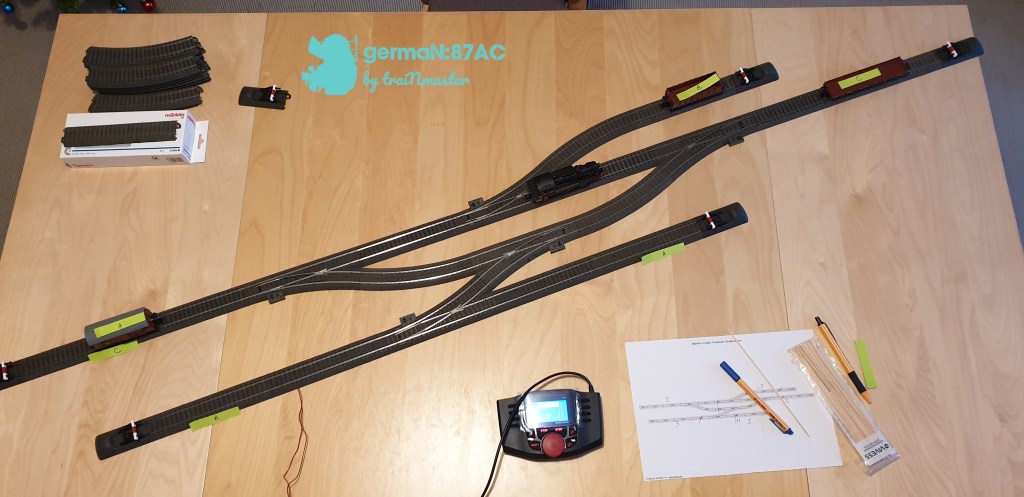
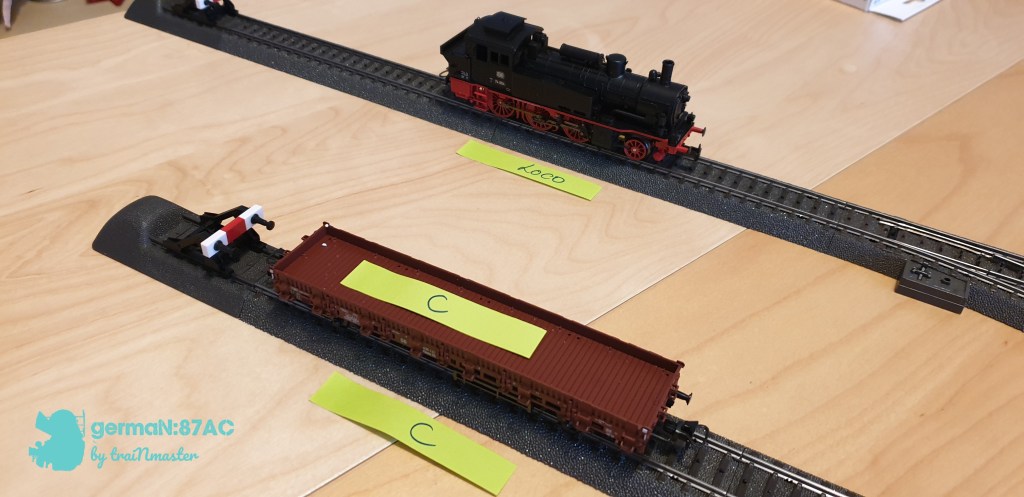
Once you finished game, move the siding markings randomly to other spots and start a new game. The labels on the cars do not need to be removed.
For more challenge, you can even put 2 cars in a particular order on the same siding as shown below.
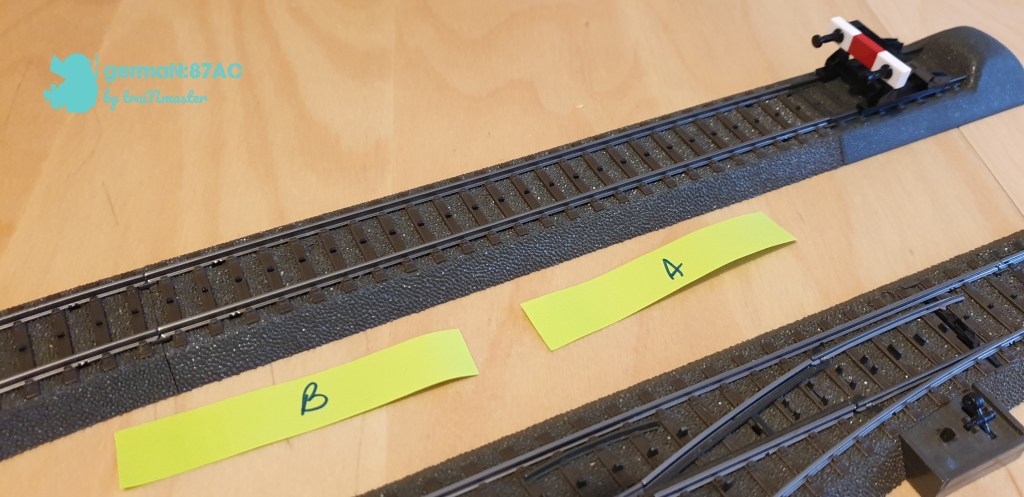
“Complete the switching as quickly as possible.”
John Allen
Time is Essence
On the original Timesaver puzzle, the speed of the loco (engine as they called it in North America) is preset to run at constant speed. There is a toggle switch to move the loco forward, backward and stop. In my case, I reduced the wiring complexity and rely on the Mobile Station 2. Therefore, each player can adjust the speed appropriately but beware not to hit them other cars or derail. There is a penalty for that!
Decoupling Cars and Switching the Turnouts by Hand
Other than the tender loco which has a built-in mfx/DCC decoder and the Mobile Station 2, everything else is “analog” – i.e. by hand.
I want to make the layout mobile so that I can take it anywhere – Märklin Insider Stammtisch meet, run it at home on the table or floor or any friend’s place. Therefore, the only wiring is the wires from the track box to the track.
I have thought about Märklin Uncoupler Track 24997 but as explained above, I do not want additional electrical connections (plus, I want to reduce the cost of setting up a Timesaver layout; unnecessary costs can be a deterrent)
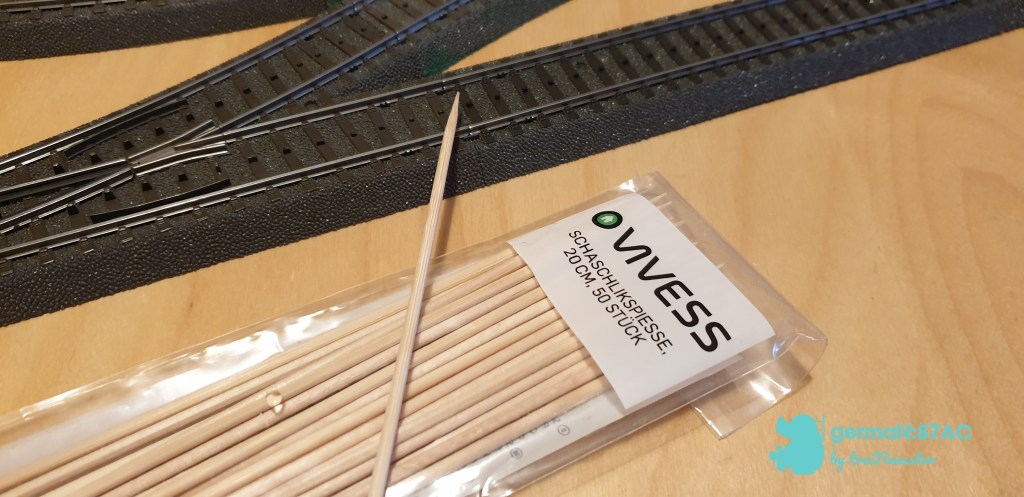
Modification to Tender Loco
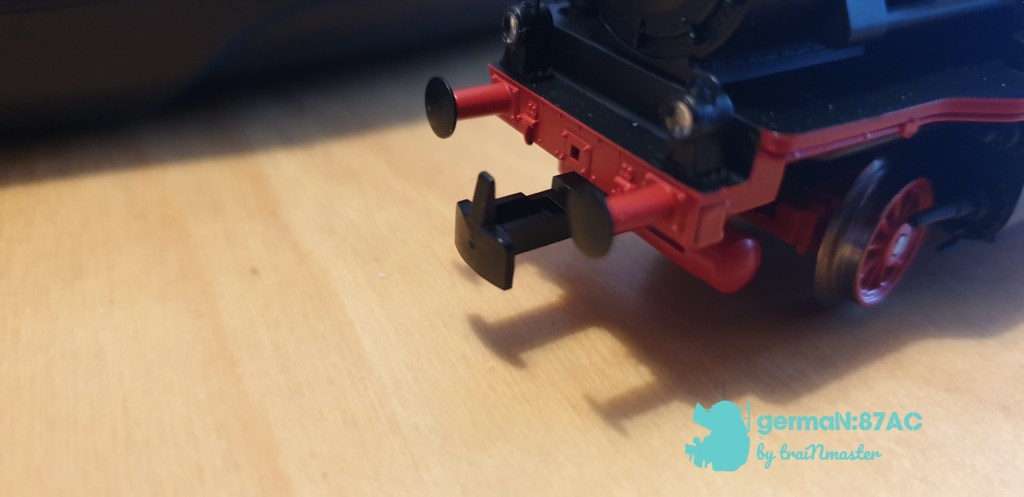
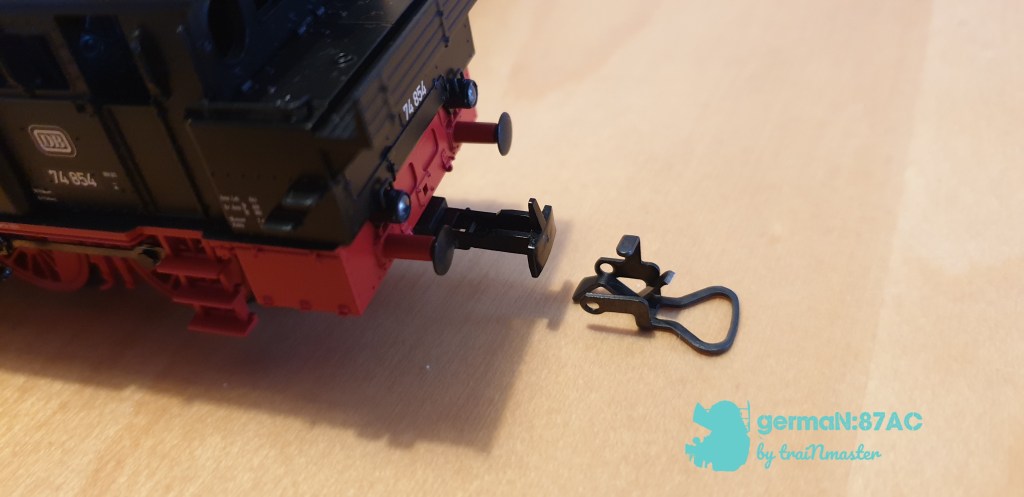
To make the coupling and decoupling easier, I have removed part of the Relex coupler at the rear of the loco. So, now the front and back couplers are the same.
The Clock Starts When …
The timer starts when you move the engine from its resting position, and ends when you return it to the designated spot, if any, or when you place the last car at its destination or all outbound cars are grouped (the referee will spell out the start/stop rules)
The timer is paused only and for the duration when the loco loses electrical contact and needs a helping hand to reestablish contact.
And Now, The Penalties!
Time penalty of 1 minute is added for each of the following faults:
- Derailment of cars and/or loco due to e.g. running against the opposite position turnout, or accidentally hitting the cars off the track,
- Running against opposite position turnout even if there is no derailment i.e. not throwing the turnout to the correct position;
- Moving the cars with your hand. Coupling adjustment and decoupling must be done with the decoupling “magic wand”.
No penalty applies if the loco loses electrical contact and need a helping hand reestablish contact.
Additional Tip(s)
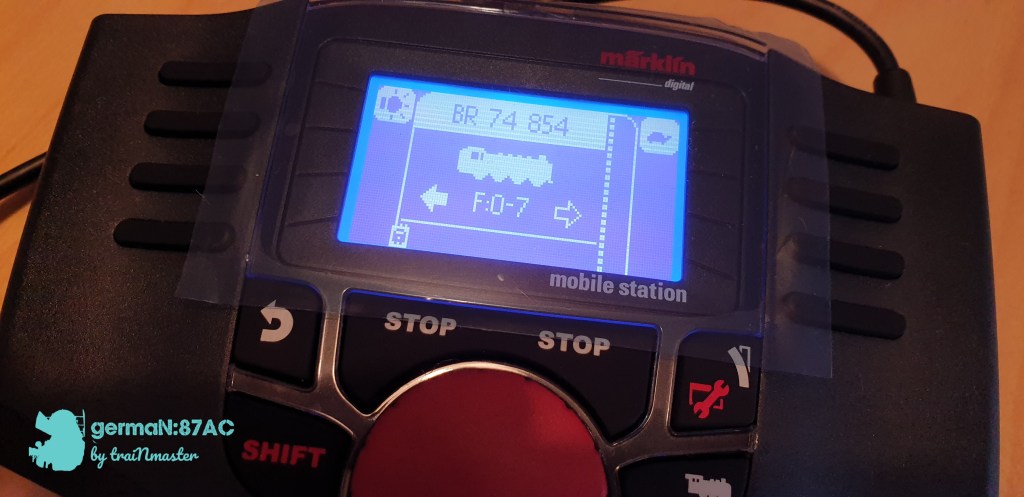
- If you are using Märklin/Trix Mobile Station 2, turn on the F0 directional lights and F4 Shunting Mode (Turtle icon) for BR 74 tender loco. Please check your manual for the position of the directional lights and shunting mode for your loco.
(Foto: Jimmy Low (c))
Directional lights tell you if you are in forward or reverse direction. Shunting mode ensures the loco stop exactly where you want to stop rather than a delay deceleration.
Enjoy your Timesaver challenge!
Same Procedure Every … Time!