Review: KPF-Zeller H0-Rollerprüfstand (Rolling Test Stand) Part 2 (Updated)

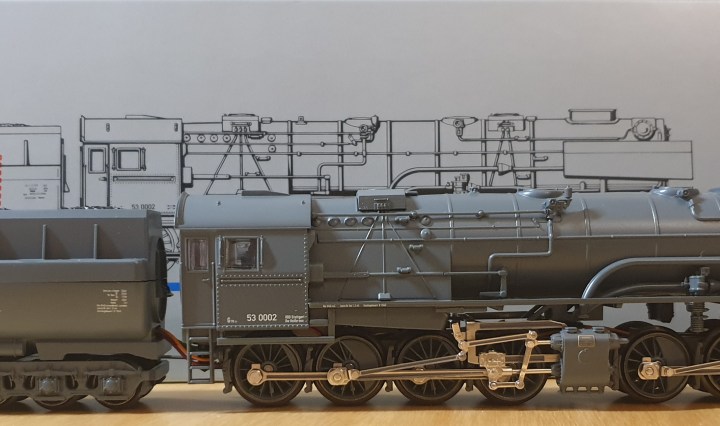
Disclaimer: This independent review is based on my personal purchase and experience. I am in no way associated with the seller other than this arm-length commercial transaction. Update 27.11.21: I have successfully ran Märklin BR 53 0002 on KPF-Zeller rolling test stand, powered and controlled by z21 digital control center and app. This post has been updated accordingly. In Part 1 review last week, I covered static tests i.e. using the rolling test stand as a display. The overall results are impressive. I believe KPF-Zeller exclusive edition is the only one in the market with underside lighting. This weekend (14.11.21) … Continue reading Review: KPF-Zeller H0-Rollerprüfstand (Rolling Test Stand) Part 2 (Updated)

Review: KPF-Zeller H0-Rollerprüfstand (Rolling Test Stand) Part 1

Disclaimer: This review is based on my personal purchase and experience. I am in no way associated with the seller other than this arm-length commercial transaction. Recently, I acquired a Märklin BR 53 0002 but not any tracks and digital control center e.g. Mobile Station 2 to run it. I decided to delay purchasing any tracks until I research more about Märklin tracks – C- or K-Gleise – and have the space to run them. But I still need to test and run my BR 53.0 and other HO-scale locomotives. After enquiring in Facebook groups. I was tipped to consider … Continue reading Review: KPF-Zeller H0-Rollerprüfstand (Rolling Test Stand) Part 1

Deciphering German Railway Periods and Modeling Epochs

For those of us modeling German railways, we are confronted with the term “epoch” or “era“. You will notice these terms Epoch/Era I-VI (henceforth I will use the term “Epoch“) on manufacturers’ and dealers’ website to describe the railway period which the rolling stocks (locomotives, passenger and freight wagen, etc.) are associated with. How strict does one follow the modeling epoch? Well, if you are a free-lanced modeler for example, where you mix-and-match whatever rolling stocks you acquired on your layout or you run some museum trains on modern-epoch layout, then it does not matter. Some stick to a particular … Continue reading Deciphering German Railway Periods and Modeling Epochs

germaN:87AC has Sister Site germaN:160

For those who know me, know that I am an N-scale and DCC modeler for many years. Moving to Märklin H0 and AC system may sound like I have “jumped ship” (figuratively). That is definitely not the case. When I decide to acquire my first German steam locomotive (I have a LNER Class A4 Mallard 4468 in OO-scale from Hornby), it was a conscious decision that it will be HO-scale (pronounced in German H0 (Ha-Null)) AND a Märklin. I am not giving up my dream to restart my N-scale layout germaN:160 “Somewhere in Germany”. My blog germaN:160 serves as my … Continue reading germaN:87AC has Sister Site germaN:160

germaN:87AC in Märklin H0 AC

I have been dabbling in the DC model railway for more than 10 years mainly in N-scale (1:160) for obvious reasons: I like to run and operate long-trains – passenger or freight and due to lack of space to build a reasonable layout to realize this vision, N-scale is an obvious choice. To me, it is a good balance between size, availability of modern-era rolling stocks and the operational realism that I wanted to achieve. Hence, germaN:160 was born, representing Epoch VI (2007 – present) My interest in HO-scale has always been latent; knowing that I could not afford the … Continue reading germaN:87AC in Märklin H0 AC