Defining Contours and Depth on Loewenherz Modules

The MIST-61 module standards define the end module as an important element for integration and transition between modules to ensure seamless interoperability. Any modular layouts such as FreMo follow such design principle. Anything between two end modules is up to the individual. As for Loewenherz module, it consists of 2 segments – each segment is 1080mm x 150mm – as shown below. Can these 2 segments be separated to form individual module? Short answer, Yes. The long answer: each segment, which I marked above as Module 1a and 1b can be taken apart and connect to other’s modules. This is … Continue reading Defining Contours and Depth on Loewenherz Modules

Building H0 Plinths for Exhibitions

Locomotives and wagons on exhibit needs a stable foundation to rest. In fact, Loewenherz has at least 3 plinths for permanent and revolving exhibits. I experimented with 10mm plywood and 3mm cork as materials for various forms of plinths. Each material has its own merits – weight, stiffness, ease to mold etc. as well as look-and-feel. I wanted to experiment. Material: 10mm Plywood vs 3mm Cork In terms of hardness, no doubt plywood fulfilled its purpose. You need a wood saw and other tools to cut into shape. Cork is easy to cut with a paper cutter and shape but … Continue reading Building H0 Plinths for Exhibitions

Designing a Stable Module Framework

The last time I designed and built modules was back in 2014 when I had space temporarily for my 4 x 1.5m N-scale “Somewhere in Germany” segment layout. I have learned a lot from my experience and provides me a good understanding and knowledge how to build Loewenherz modules. MIST-61 adopts the module standards and practices from MIST-55 (Mainz). The end module is 450mm x 150mm. The length of each module is up to the members. I chose 1080mm using standard pieces of Märklin C-tracks 24172 and 24188. Module Construction Drawing I am a perfectionist and stickler for details. I … Continue reading Designing a Stable Module Framework

From Conception to Realisation: Module “Loewenherz Railway Park”

In April, my home club Märklin Insider Stammtisch 61 (MIST-61) had our first operating session after 2 years hiatus due to the Corona pandemic. This was my first official appearance as a MIST-61 member. It was a great learning curve for me as I helped with the setup of various modules and had a look at how various members designed, constructed and landscaped their respective layouts. Feeling inspired by the beautiful, detailed and awesome layouts, I considered long and hard, what I was for my first module. The Birth of “Railway Park” Modules I have 2 Märklin steam locomotives (so … Continue reading From Conception to Realisation: Module “Loewenherz Railway Park”

Märklin/Trix Timesaver Setup and Play Manual in 5 Languages (DE/EN/ES/IT/NL)

I am happy to announce the release of the Märklin/Trix Timesaver setup and play manual in 5 languages. It took me and my team of volunteer translators 1 month to write and translate the adaptation of John Allen’s famous Timesaver switching puzzle for Märklin and Trix track systems. I published my initial idea for a Märklin Timesaver early January 2022 and called volunteers to translate them in German, French, Spanish, Italian and Dutch. 4 responded immediately and we coordinated our works during evenings and weekends as well as from different time zones. My German translator Stefan Hervel lived in New … Continue reading Märklin/Trix Timesaver Setup and Play Manual in 5 Languages (DE/EN/ES/IT/NL)

Märklin/Trix Scissor Crossings

I flipped through the Märklin Full Line catalog and could not find any C-track scissors crossing. Using SCARM software, I drew the four configurations for standard C-tracks and one for compact (slimmer) C-track turnout. Standard C-track Turnouts (24611 / 24612) Slim / Compact C-track Turnouts (24711 / 24712) Take note that you need to cut side of the embankments on the colored pieces 24064. Märklin recommends using 24071 in combination with these slim turnouts 24711/24712. Unfortunately, using the 24071 will cause a gap that could not be filled by other smaller straight pieces. Here is an example how different combinations … Continue reading Märklin/Trix Scissor Crossings

Review: Keeping BR 53 Travel-Safe with TrainSafe Travel Box

Disclaimer: This review is based on my personal purchase and experience. I am in no way associated with the seller other than this arm-length commercial transaction. My biggest and most precious Märklin H0 model investment so far is the Baureihe 53 0002 DRB, a Borsig Mallet. It was a beautifully-maintained pre-owned model and I have recently upgraded with Märklin high-performance motor, mfx-decoder with sound and two smoke generators (see post). This Märklin model was constructed between 1995 and 1999 according to some reliable sources. The original plastic packaging fell into pieces – 4 pieces to be exact due to years … Continue reading Review: Keeping BR 53 Travel-Safe with TrainSafe Travel Box

BR 53 0002 Borsig Mallet Received a Major Upgrade

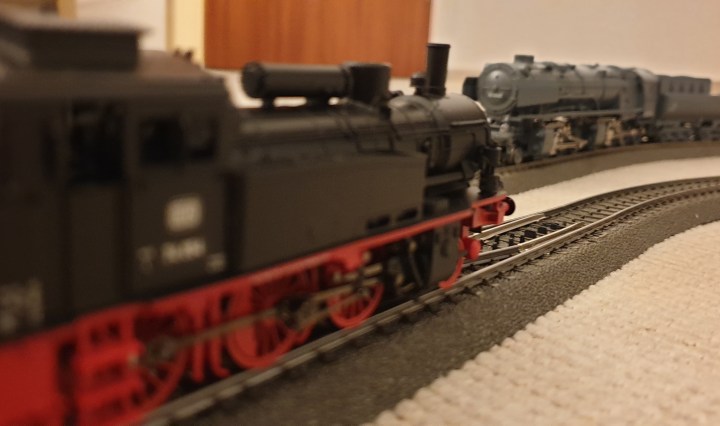
When I bought Märklin Baureihe 53 0002 (article no. 3701), it was a love-at-first-sight. According to some records, this model was produced between 1995 and 1999 and comes with a Digital/MM decoder, which has limited function namely, I could turn on/off the head/tender lights. No sound, no smoke generators. It is a beautiful machine. The Wehrmacht (or officially Iron Grey) livery made it standout among the “standard” black/red livery steam locomotives from Epoch II onwards. I planned for an upgrade since the acquisition and researched more about BR 53 and Märklin decoders. Finally, our Märklin H0-Forum group expert showed a … Continue reading BR 53 0002 Borsig Mallet Received a Major Upgrade

Countdown to Märklin/Trix Timesaver Manuals Launch

Update 06.04.22: I am pleased to announce the release of Märklin/Trix Timesaver Setup and Play manuals in 5 languages DE/EN/ES/IT/NL. Update 16.02.22: The launch has been delayed due to some ongoing clarifications. A new date will be announced. I did not expect that I will publish a Märklin/Trix Timesaver manuals in such a short period. The name “Timesaver” is not foreign to me as I have John Allen’s Nov. 1972 Model Railroader article of the same name for more than 10 years now. Back and even earlier, I was a US N-scale modeler, focusing on BNSF Galvestone Subdivision which I … Continue reading Countdown to Märklin/Trix Timesaver Manuals Launch