

Recently, I came across an advertisement on Hornby OO gauge 17mm (note: Hornby did not mention the distance) magnetic buckeye (R7398), 17mm magnetic vacuum pipe (R7400) and 20mm magnetic vacuum pipe (R7399) couplers. They appeared interesting for me wanting to explore more about them. Aesthetically the buckeye (or in USA it is called knuckle) couplers and vacuum pipe couplers look realistic. Both have small magnets at the end, which are how the couplers stay attached and easy to uncouple by pulling the cars apart.


Testing Hornby Magnetic Couplers with Märklin Couplers
At this moment, I can only test the Hornby magnetic buckeye couplers and compare with Märklin couplers. There are basically two types of Märklin H0 couplers – Relex couplers (72060) and close couplers (72010). Within the close couplers variations, there are the new NEM close couplers (72000) and power conducting close couplers (072025). These are not covered in my tests.

Relex couplers come pre-installed on most, if not all, continental Europe H0-scale (1:87) locomotives and rolling stocks, such as from big names like Märklin, Roco, Brawa, etc. If you want to close couplers, you need to purchase them separately e.g. Märklin 72010 comes in 10 pieces per pack for 5 rolling stocks or Märklin 72000 comes in 50 pieces per pack for 25 rolling stocks.
My test covers only Märklin relex and close couplers as shown above.
Spacing Between Rolling Stocks
The Relex couplers create a distance 23mm without slack (stationary or when being pushed) and 26mm with slack (when being pulled) between car bodies. You can see the spacing between buffers.

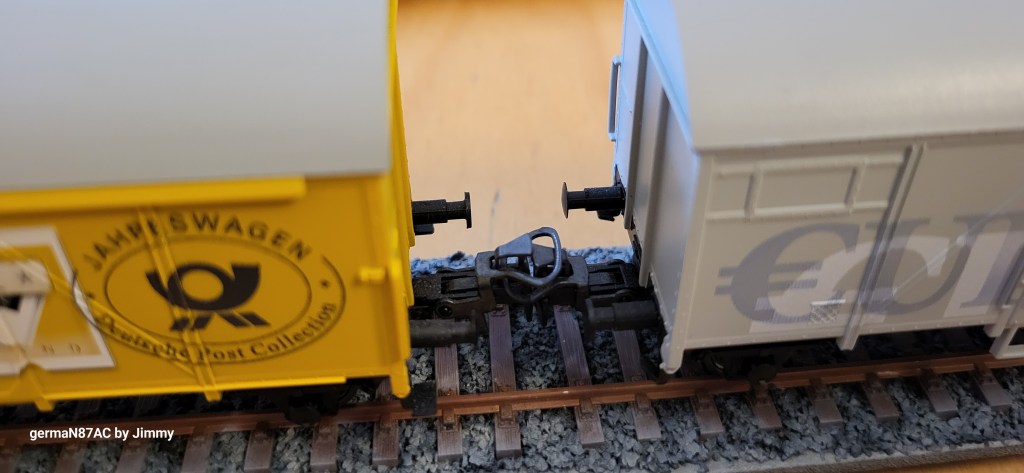
Relex couplers spacing between car bodies and buffers
Using close couplers and Hornby magnetic buckeye couplers, the space between the car bodies is reduced to 16-17mm. With Märklin close couplers, there is not tension or slack on the couplers; hence, many Märklin modellers switch to these close couplers. The Hornby magnetic couplers also maintained the same body spacing and as the magnets hold the cars tight, there is basically no slack. The spacing between buffers is significantly reduced. Märklin close couplers maintained the smallest distance between car bodies and buffers among all 3 types.
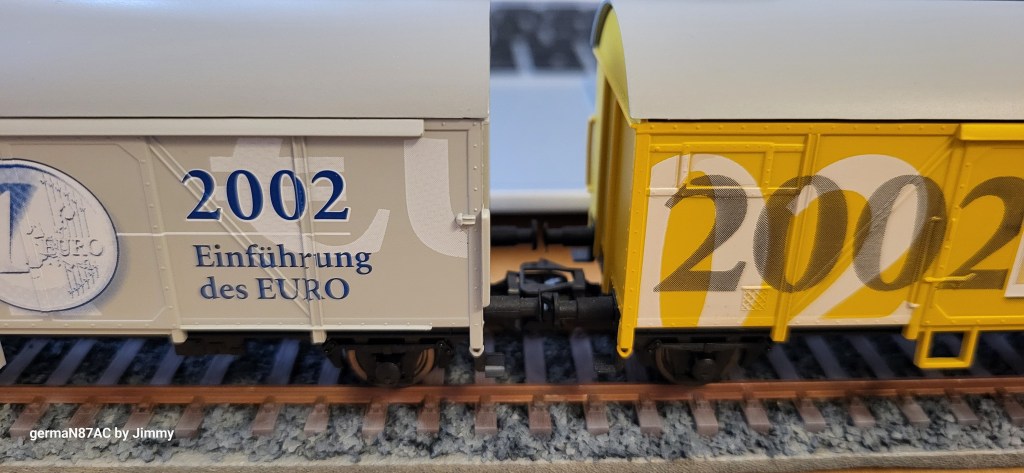
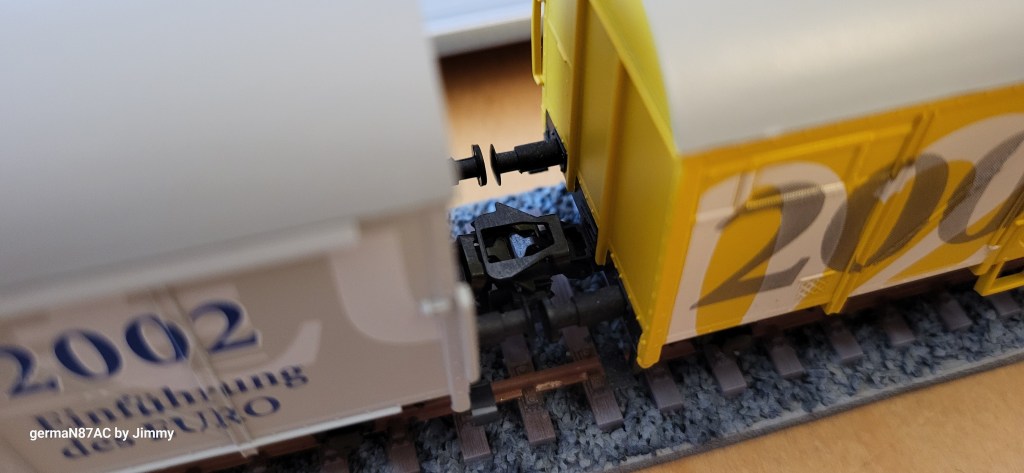
Marklin close couplers spacing between car bodies and buffers


Hornby magnetic buckeye couplers spacing between car bodies and buffers
Hornby Magnetic Couplers on Curved Tracks and Turnouts
How do the Hornby magnetic couplers perform on curved tracks and turnouts? Given the narrow distance between buffers, would these couplers cause buffer locks i.e. the buffers jamming and thus, a potential derailment?
I used Märklin R2 curved track to answer these questions. The R2 curved track has a radius of 437.5mm (R1 has 360.0mm). The buffers are touching each other on these R2 curved tracks.

Left buffers are touching each other on R2 curved track
For the turnout test, I used Märklin left turnout (Art. 24611). The curved portion is equivalent to a R2 curved track. As it passed the turnout, it seems like there is a chance of buffer lock (see middle photo).

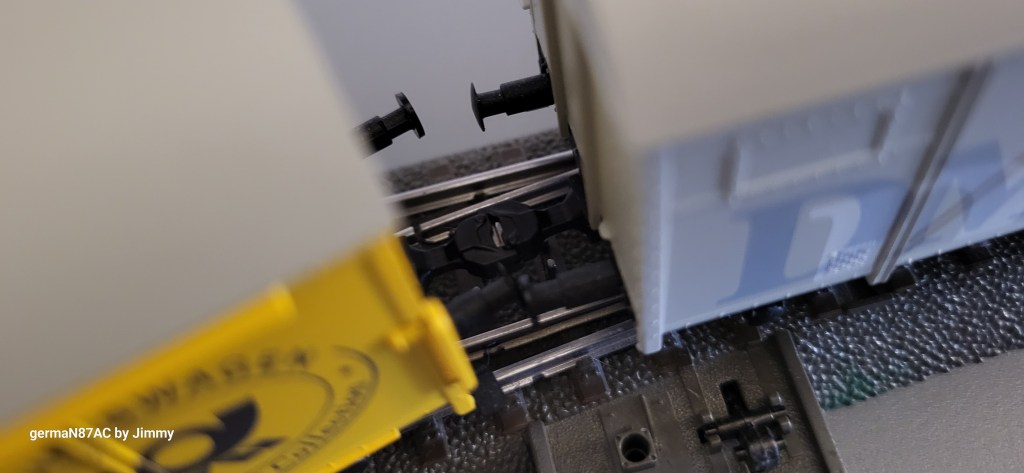
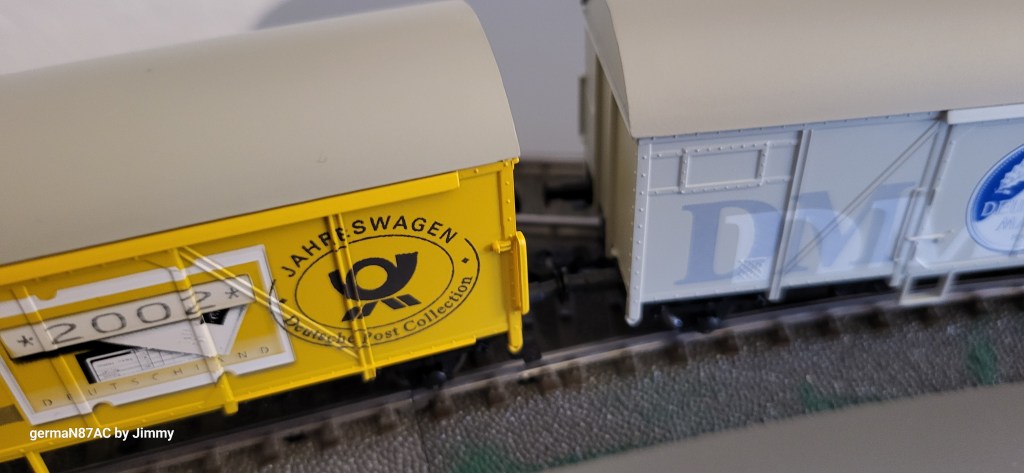
A tight turnout may risk a potential derailment for Hornby magnetic couplers
The chance for derailment is possible for Hornby magnetic couplers (a) if the curved track is less than R2 (437.5mm) or on a turnout, (b) passing the turnout at high speed, and/or (c) the buffers are different heights.
Coupling and Uncoupling
Coupling Märklin relex and close couplers requires some effort. The metal buckles might need to be lifted to ensure the couplers are fastened properly and prevent uncoupling when in motion. On the other hand, Hornby magnetic buckeye couplers can fasten easily with a click. The magnets will draw the couplers together when they are a few mm from each other.
Uncoupling Märklin couplers requires some device to lift the buckle up and move the cars away from each other. On the other hand, Hornby magnetic couplers would uncouple by pulling the cars apart. At this moment, there is no device to uncouple this type of Hornby magnetic couplers.
Price Comparisons and Conclusion
In terms of performance, I have explained them as per above. How do these couplers compare from price-point? In what circumstances is worth converting to Hornby magnetic couplers?
| TYPE | DISTANCE Between CarS | Price per PAIR (RRP*) | Comments |
|---|---|---|---|
| Märklin relex couplers (72010) (10pcs pack) | 23-26mm | 2.90€ | Comes pre-installed on most continental Europe HO rolling stock. NEM 362 socket required |
| Märklin close couplers (72060) (10 pcs pack) | 17mm | 2.90€ | NEM 362 socket required |
| Märklin close couplers (72000) (50 pcs pack) | 17mm | 2.40€ | NEM 362 socket required |
| Hornby magnetic buckeye couplers (R7398) (16 pcs pack) | 17mm | 2.30€ | NEM 362 socket required |
* I used manufacturers’ recommended retail price (RRP) for comparison as retailers offer different discounts and vary in retail prices. Hornby’s RRP is 15.99 GBP at time of this blog. I converted to Euro based on 1.00 GBP to 1.15 Euro.
While Hornby offers the lowest price point per pair, is this the only motivation to change or choose Hornby? Personally, if you are going for major coupler conversion to close couplers, the price point between the Märklin 50 pcs pack and Hornby is about 10 Euro cents per pair. In terms of reliability, Märklin type seems more secure against uncoupling when in motion. Aesthetically, I find the Hornby couplers look “less bulky”. Hornby couplers look good for fixed consists such as passenger coaches or freight cars as these do not require constant coupling and uncoupling.
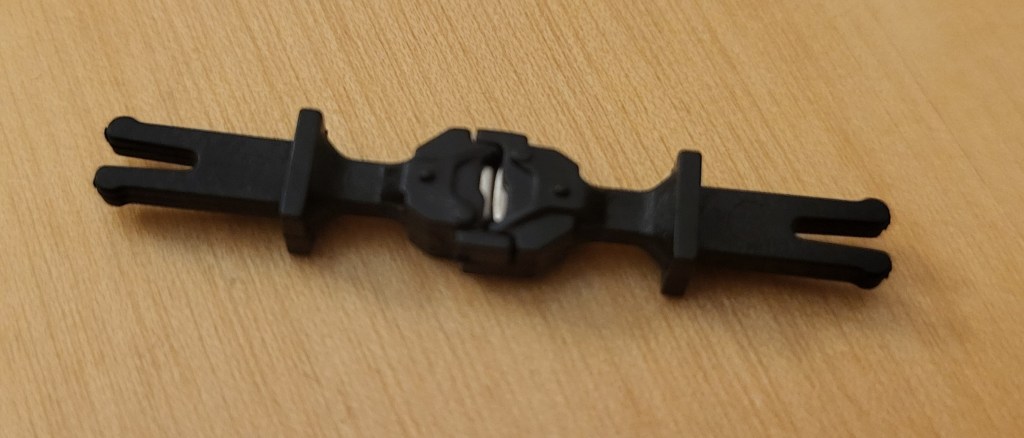
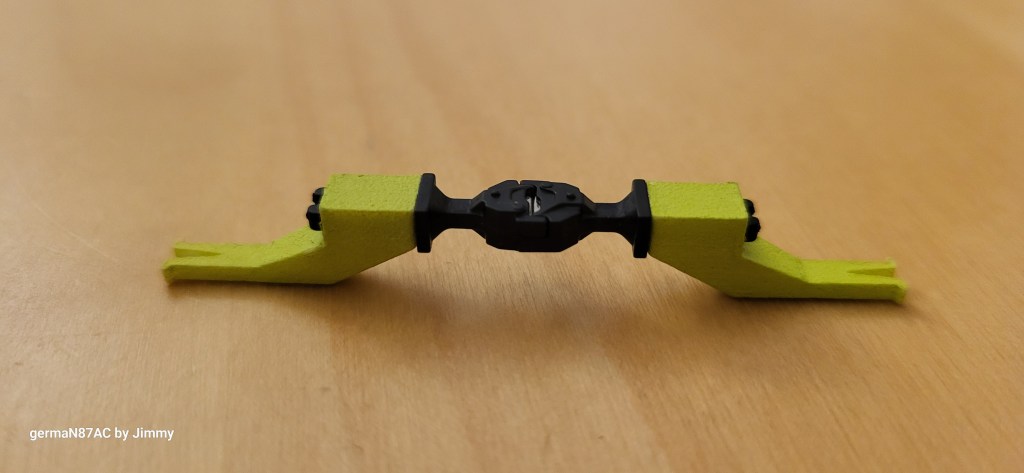
I would choose these Hornby magnetic buckeye couplers for my RailAdventure rolling stocks. Some require special adapter such as the one below. The magnetic couplers help with quick coupling and uncoupling.

 germaN:87AC :: Steam Experience Across Germany
One thought on “Review: Hornby Magnetic Buckeye Couplers Perform Well”