

7th December 1835 marked the historical start of railway travel in Germany. The first 6.04km between Nuremberg and Fürth shortened the travel time between the two trade cities by 10 minutes. Almost 3.5 years later on 7th April 1839, the first long-distance passenger rail travel between Leipzig and Dresden was completely, the 88km stretch that was built in stages over 2 years.
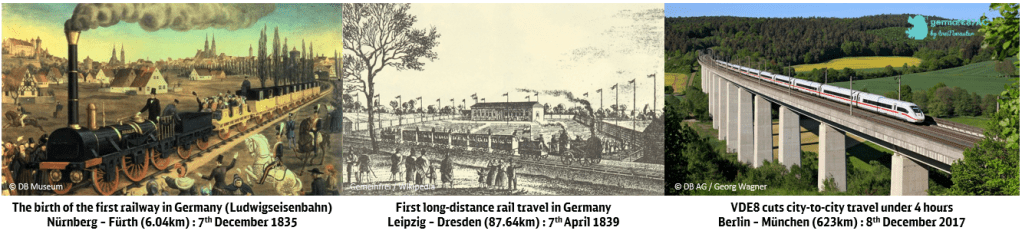
8th December 2017 marked another landmark achievement in the German railway history. The completion of VDE 8 shortened the travel time between Berlin, the capital of Federal Republic of Germany, and Munich to under 4 hours.

186 years since, railway becomes an integral part of Germany. Its InterCity Express or ICE is the flag bearer of the railway technology progress. Today ICE also symbolizes environment-friendly travel on 100% renewable energy. The ICE and its sister InterCity too celebrated their 30th and 50th anniversary respectively this year.
Note to my readers: I use the plural noun “German Railways” to include all the previous state railways (Länderbahnen) before 1920s as well as two German railways between 1949/51 and 1993 – Deutsche Bundesbahn (DB/BRD) and Deutsche Reichsbahn (DR/DDR). Although today Deutsche Bahn still holds the lion share of the railway passenger and freight traffic, I want to also acknowledge all the private railways that contribute to the development and importance of railway in Germany.
 germaN:87AC :: Steam Experience Across Germany